Disclaimer: The information provided in this article is for general informational and educational purposes only. It does not constitute legal, tax, accounting, or professional fundraising counsel. Readers should consult qualified professional advisors for guidance on specific legal, financial, or fundraising compliance matters.
Hiring a consultant can be a transformative step for a nonprofit organization. Whether you need help designing a strategic plan, upgrading your donor database, or training your board of directors, external expertise can provide the clarity and capacity your staff might lack. However, one of the most common hurdles for leaders is budgeting for these services. How much does a nonprofit consultant cost, and how are these fees determined?
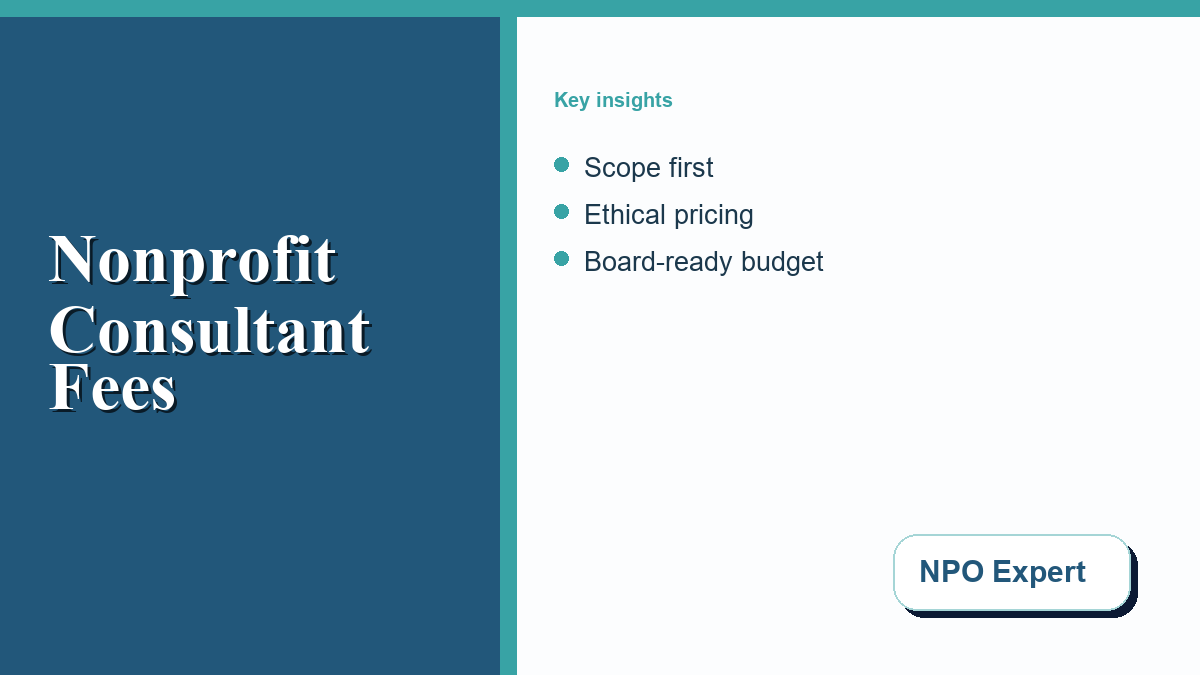
Nonprofit consultant fees depend on scope, specialty, geography, deliverables, and experience. A useful budget starts by defining the problem, deliverables, timeline, and ethical compensation model. Rather than searching for a single universal price, nonprofit leaders can achieve better outcomes by understanding how fees are structured and how to align these costs with organizational goals.
Quick Answer: How Nonprofit Consultants Charge
Nonprofit consulting rates vary, but directional survey data offers a clear picture of the industry landscape. According to the Nonprofit.ist 2025 Consultant Cost and Compensation Survey, compiled by Whole Whale and reported by The NonProfit Times, the average hourly rate for a nonprofit consultant rose to $159 in 2025. This represents an increase from the 2024 average of $151, and a substantial jump from the 2020 average of $110.
However, hourly rates only tell part of the story. The same Nonprofit.ist survey data indicates that 4.2% of consultants do not charge by the hour at all, opting instead for flat-rate, project-based, or value-based pricing. Furthermore, the survey revealed that academic credentials do not necessarily dictate rates: consultants with a bachelor’s degree billed an average of $156 per hour, while those with a master’s degree averaged $149, and those with a doctorate billed $140. In the nonprofit sector, organizations consistently prioritize practical experience, a proven track record, and specific deliverables over academic credentials.
Additionally, the data shows that most independent consultants cluster between 20 and 24 billable hours per week, spending the remaining 5 to 14 hours on administrative tasks, marketing, and professional development. This administrative overhead is built directly into their hourly rates, which is why contracting a consultant often carries a higher nominal hourly cost than hiring a staff member of equivalent seniority.
Common Fee Structures in Nonprofit Consulting
Nonprofit consultants typically structure their agreements in one of five ways. Selecting the right model depends on the nature of your project and your budget flexibility.
1. Hourly Rates
Under an hourly structure, the nonprofit pays for the actual hours the consultant spends working on the project. This model is ideal for coaching, ad-hoc advisory services, or projects with fluid, hard-to-define boundaries. The risk is that costs can escalate if the scope is not strictly monitored.
2. Project-Based (Flat Fee)
For projects with clear, predictable deliverables, a flat project fee is often the best choice. In this model, the consultant charges a fixed sum for the entire scope of work, regardless of how many hours it takes to complete. This is the preferred structure for strategic planning, board training workshops, or executing specific deliverables like writing donor appeals.
3. Monthly Retainer
A retainer agreement involves a set monthly fee for a pre-negotiated volume of support (e.g., 10 hours of consulting per month). Retainers are common for fractional executive support, ongoing marketing services, or recurring monthly board governance advising. This structure provides budget predictability for the organization and reserved capacity from the consultant.
4. Day Rates
Some consultants charge a flat rate for a single day of work. This model is frequently used for intensive, single-day events, such as facilitating a board retreat, leading a stakeholder workshop, or conducting a rapid organizational diagnostic audit.
5. Phased Contracts
For complex or long-term initiatives, a phased contract breaks the project into distinct milestones. For example, Phase 1 might focus on discovery and data collection, Phase 2 on designing the strategy, and Phase 3 on implementation support. Each phase has its own timeline, budget, and deliverables. This structure allows the nonprofit to pause or adjust the scope between phases if organizational priorities or budgets change.
What Affects the Cost of a Nonprofit Consultant?
If you are comparing proposals, you will likely see a wide range of rates. Several key factors influence nonprofit consulting rates:
- Specialization and Complexity: General administrative support or volunteer coordination coaching will typically cost less than specialized legal, tax, IT infrastructure, or capital campaign strategy services. For advice on legal compliance or governance, see our guide on choosing a nonprofit legal structure.
- Scope and Deliverables: A project that requires dozens of stakeholder interviews, focus groups, and customized training materials will require more billable time than a project that relies on standard templates.
- Consultant Experience and Team Size: Solopreneur consultants generally charge less than large consulting firms that bring a team of junior associates and senior partners to a project.
- Timeline and Urgency: Projects requiring an accelerated timeline or immediate attention may incur rush fees due to the rescheduling of other client commitments.
- Travel and Expenses: Virtual engagements are more cost-effective. If in-person visits are required, expect to pay for travel time, flights, lodging, and meals as reimbursable expenses or integrated flat fees.
Fundraising Consultant Ethics: The Percentage-Based Compensation Rule
When researching fundraising consultant fees, nonprofit leaders must navigate a critical ethical boundary. Many leaders ask: Can we pay our fundraising consultant a commission or a percentage of the funds they raise?
The short answer is no. Ethical fundraising standards strictly prohibit percentage-based compensation. According to the Association of Fundraising Professionals (AFP) Code of Ethical Standards, members must not accept compensation or enter into contracts that are based on a percentage of contributions, nor shall they accept finder’s fees. This position is elaborated in the AFP Professional Compensation Position Paper.
This ethical restriction exists for several important reasons:
- Donor Trust: Donors give money with the expectation that their funds will directly support the charitable cause, not enrich a third-party fundraiser. Percentage-based compensation can make charitable giving feel like a commercial transaction.
- Conflicts of Interest: Paying a fundraiser by commission can incentivize high-pressure or manipulative tactics, prioritizing short-term financial gains over long-term, relationship-based donor stewardship.
- Fairness and Windfalls: A donor may decide to make a large contribution based on years of relationship building by the board and executive director. A percentage-paid consultant hired last week should not receive a massive windfall from that gift when their actual contribution to the donor’s decision was negligible.
Instead of commissions, fundraising consultants should be paid using flat project fees, hourly rates, or retainer models that reflect their time, expertise, and operational costs. Ensure your contract explicitly states that fees are based on services rendered, not fundraising outcomes.
Informal SOW vs. Formal RFP: Which Do You Need?
Before contacting consultants, decide how you will solicit proposals. A complex, time-consuming Request for Proposal (RFP) process may not be necessary for every engagement. For smaller projects, a collaborative Scope of Work (SOW) is often faster and more effective.
Below is a general framework for choosing between a direct SOW agreement and a formal RFP:
| Project Size and Type | Procurement Method | Key Elements to Include |
|---|---|---|
| Small Projects (e.g., under $5,000; basic board workshop, minor database troubleshooting) |
Direct Scope of Work (SOW) Consult with 1-2 trusted independent advisors and establish a direct agreement. |
Project background, specific tasks, direct timeline, payment schedule, and communication terms. |
| Medium Projects (e.g., $5,000 to $25,000; minor database migration, standard strategic plan update) |
Informal RFP / SOW Comparison Draft a 2-page brief and send it to 2-3 selected consultants for proposals. |
Clear objectives, technical requirements, evaluation criteria, and a requested budget range. |
| Large Projects (e.g., over $25,000; full capital campaign feasibility study, multi-system CRM migration) |
Formal Consultant RFP Publish a formal request to attract multiple competitive proposals. |
Detailed organization background, complex scope, stakeholder expectations, budget range, and reference requirements. |
What to Include in a SOW or RFP
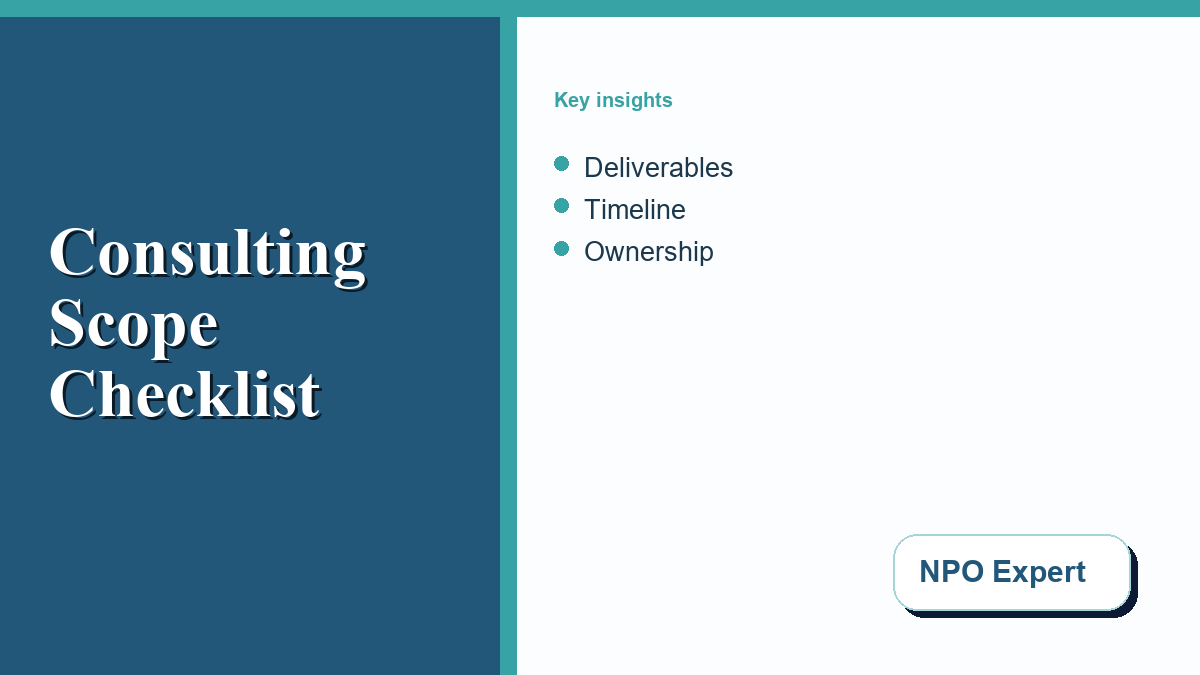
Whether drafting an informal project brief or a formal RFP, ensure the document contains these essential components:
- Background and Context: Tell the consultant who you are, what your mission is, and what challenge you are trying to solve.
- Objectives: Define what a successful project looks like.
- Scope and Deliverables: Specify what tasks the consultant will perform and what tangible products (e.g., reports, training sessions) they are expected to deliver.
- Timeline and Milestones: Provide your desired start date, major checkpoints, and final deadline.
- Budget Range: Stating your budget range upfront prevents wasting time on proposals that are financially out of reach.
- Confidentiality and Ownership: Outline that the organization owns the work product and that sensitive internal data will remain confidential.
Critical Questions to Ask Before Hiring a Consultant
Evaluating consultant proposals requires looking beyond the price tag. The cheapest bid can sometimes cost more in the long run if the work is poor or incomplete.
When interviewing potential consultants, ask these essential questions to ensure a good fit:
- “What is your experience with organizations of our size and subsector?” A consultant who only works with multi-million dollar university foundations may not understand the resource constraints of a small local animal shelter.
- “How do you structure your fees, and what is your policy on out-of-scope work?” Ensure you understand how additional requests will be handled and billed.
- “Who will actually be doing the work?” In larger firms, senior staff may pitch the project, but junior associates may handle the day-to-day execution. Know who your main point of contact will be.
- “How do you measure the success of this engagement?” Make sure you and the consultant agree on what constitutes a successful outcome.
- “Can you provide references from recent clients who completed a similar project?” Speaking directly to former clients is the best way to verify a consultant’s reliability, communication style, and effectiveness.
Hiring Red Flags to Watch For
Protect your nonprofit’s assets and reputation by keeping an eye out for these consulting red flags during the negotiation process:
- Vague or Undefined Deliverables: If a proposal promises to “improve organizational efficiency” but does not detail what reports, training, or tools will be delivered, ask for clarification before signing.
- Unclear Intellectual Property Terms: The contract should clearly state that your nonprofit owns the final strategic plans, donor lists, or custom manuals created during the project. Avoid agreements where the consultant retains exclusive ownership of your customized work products.
- Commission-Based Fundraising Structures: If a fundraiser insists on a percentage of funds raised rather than an hourly rate or flat project fee, walk away. Citing AFP ethical rules protects your organization’s credibility.
- Lack of Confidentiality and Data Security Terms: Nonprofits handle sensitive donor information and internal financial data. The contract should include clear confidentiality and non-disclosure clauses to protect your proprietary information.
Effective Budgeting for Your Consulting Needs
Hiring a nonprofit consultant should not be viewed as an administrative overhead expense, but as an investment in your organization’s capacity and future sustainability. By defining your scope clearly, selecting an appropriate fee structure, adhering to ethical standards, and asking the right questions, you can ensure a productive partnership that delivers lasting value to your mission.