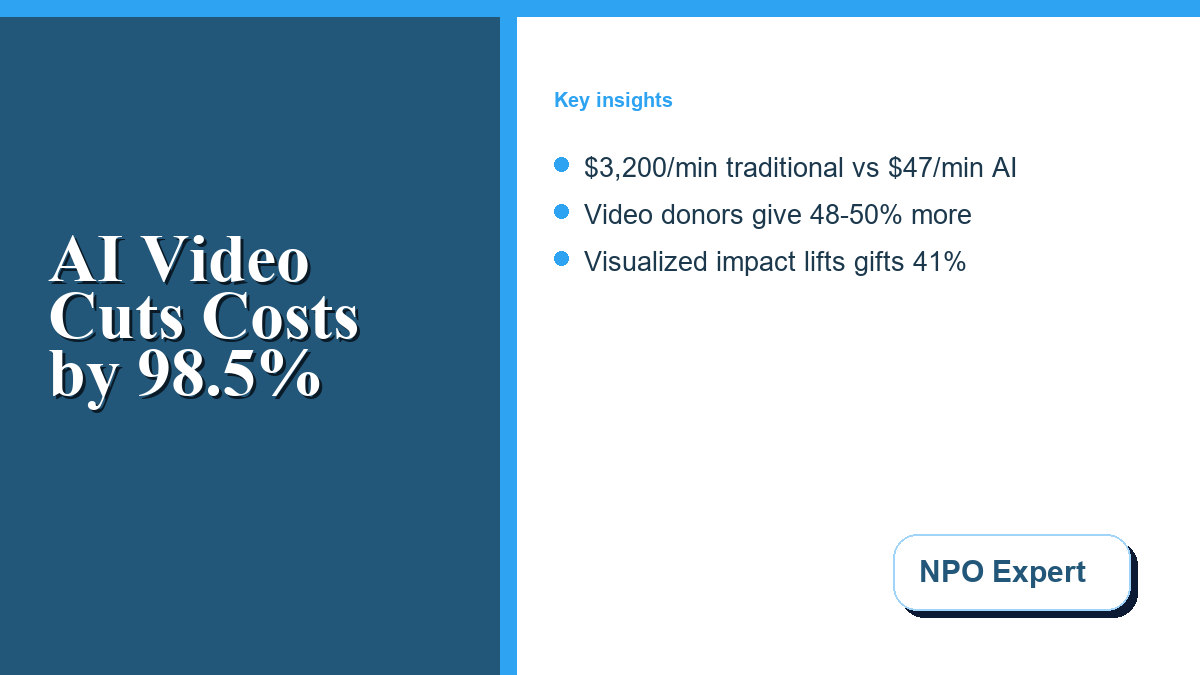
Traditional video production runs nonprofits an average of $3,200 a minute — a cost that quietly excludes most small and mid-sized organizations from a format that consistently outperforms every other appeal type. AI-assisted video has changed that math dramatically, bringing the same minute down to roughly $47 on average, a reduction steep enough to put video storytelling within reach of organizations that could never have budgeted for it before.
Why Video Specifically Moves Donors
Nonprofits using video storytelling effectively raise 48-50% more in donations than those relying on text alone, and 72% of donors report being “very likely” to give after watching a nonprofit’s video. The effect compounds across channels: emails containing video generate 26% higher click-through rates and drive 4.7 times more donations than text-only appeals covering the same campaign.
What AI Actually Handles in the Production Process
The pieces that used to require a production budget — editing, voiceover, motion graphics for data visualization — are now achievable with AI-assisted tools at a fraction of the previous cost and turnaround time. That doesn’t mean a finished product with zero human input; it means the production bottleneck that used to price out smaller organizations no longer has to.
Where It Gets Genuinely Powerful: Visualizing Impact
AI-rendered visualizations of program outcomes — showing a scenario with accurate contextual and cultural detail rather than describing it in a paragraph — have been reported to increase donation amounts by as much as 41% compared to text-based impact reporting alone. For a nonprofit whose impact is genuinely hard to photograph — a policy change, a long-term outcome, a program still in progress — that’s a meaningfully different tool than stock photography or a written case study.
Building This Into the Annual Report
- Lead with a short video, not a video afterthought. A 2-3 minute video embedded near the top of a digital annual report outperforms one buried at the end.
- Use AI production for volume, not for the flagship piece. A single hero story deserves more human craft; the surrounding campaign content is where AI-assisted production earns its keep.
- Match the visual style to the organization’s actual voice. A polished corporate-style AI video can feel wrong for a grassroots organization; match the aesthetic to the audience’s expectations, not just the technical capability.
Platforms built around generating consistent, on-brand video and social content from the same underlying campaign material make it easier to produce this at the volume nonprofit communications teams actually need. Charigent’s social video feature is one example built around that kind of repeatable content production.
The Practical Takeaway
The cost barrier that used to make video an option only for well-funded nonprofits has largely disappeared. What’s left is a genuine production and storytelling decision, not a budget one.