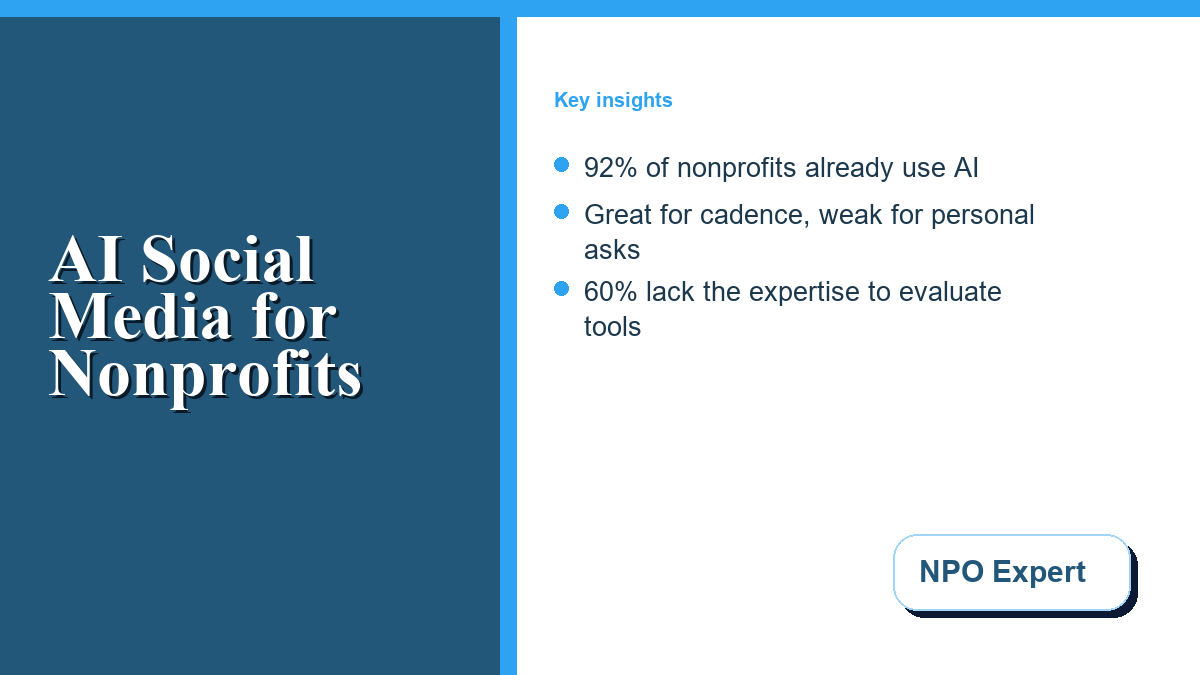
92% of nonprofits now use AI in some capacity, and 70% believe it can meaningfully cut workload and improve communications — but 60% say they don’t have the in-house expertise to actually evaluate which tools are worth adopting. That gap between belief and confidence is exactly where a lot of nonprofit budgets get spent on the wrong tool.
Where AI Social Media Tools Genuinely Help
A consistent multichannel posting cadence is one of the first things to slip when a small nonprofit team is stretched across programs, donor relations, and grant reporting. AI scheduling and content-drafting tools close that specific gap well: drafting a month of captions from a campaign calendar, adapting one piece of content across platforms, and keeping a consistent voice without a dedicated social media staffer checking in daily.
Where It Genuinely Doesn’t
Donor-facing communication that references a specific relationship — a major gift acknowledgment, a personal update to a longtime supporter — loses exactly the thing that makes it work when it’s fully automated. AI is a strong first-draft and consistency tool; it is a weak substitute for the specific, personal touch that turns a one-time donor into a recurring one. The nonprofits getting real value are using AI to handle volume and cadence, and keeping a human hand on anything that trades on an actual relationship.
The Integrated Approach Beats the Single Tool
The strongest nonprofit AI setups in 2026 combine a connected content platform with a small number of function-specific tools rather than one single do-everything app or ten disconnected point solutions. Social content, donor communication drafts, and campaign copy benefit from sharing context — a campaign theme decided once should show up consistently across the social calendar, the appeal email, and the grant report language without someone manually copying it between three separate tools.
What to Look for Before Adopting a Tool
- Does it build a real content calendar from a campaign brief, or just generate isolated posts one at a time? A connected calendar saves far more staff time than a caption generator used post by post.
- Can non-technical staff actually run it without ongoing help? A tool that requires a technical staffer to operate defeats the purpose for most small nonprofit teams.
- Does the free or entry tier cover a real campaign, or just a demo-sized sample? Several tools marketed to nonprofits are priced or scoped for testing, not sustained use.
Platforms built around a shared content and communication workspace — where a campaign brief, the social posts drawn from it, and donor-facing copy all reference the same underlying context — close the coordination gap better than a single-purpose scheduler alone. Charigent’s AI social media management use case is built around that connected-context model rather than an isolated posting queue.
The Realistic Starting Point
A small nonprofit team doesn’t need to solve every communication channel with AI at once. Picking the single most time-consuming recurring task — usually the social calendar or the monthly newsletter — and automating that first gives a team a real read on whether a tool earns its place before expanding further.